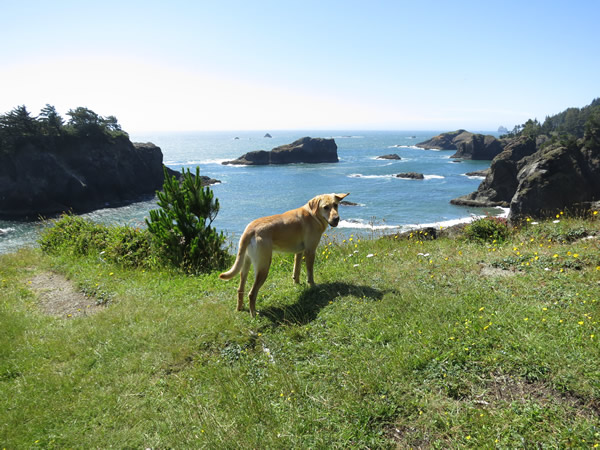
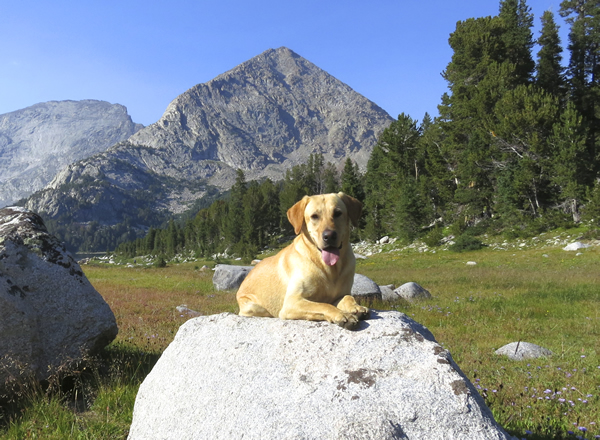
|
Reviews for Merle's Door
Merle's Door: Lessons from a Freethinking Dog Ted Kerasote. Harcourt, $25 (416p) ISBN 978-0-15-101270-1
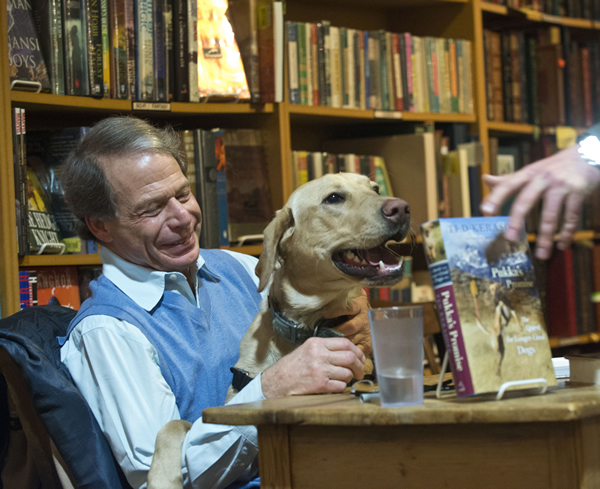
Humorous, jubilant and touching by turns, this story of the relationship between man and dog is informed by the author's grasp of animal research and his attachment to Merle, a stray dog he adopted. A Labrador mix, Merle first appeared while the author was on a camping trip. Kerasote (Out There: In the Wild in a Wired Age), an award-winning nature writer, decided to take his canine friend home to rural Wyoming. This chronicle of their 13 years together is interspersed with studies by animal behaviorists that strengthened Kerasote's desire to see Merle as a responsible individual rather than a submissive pet. Merle set his own eating schedule (though not without early mishap), refused to hunt birds (although not elks) and, according to the author, possessed a range of emotions and sentiments similar to those of humans. Kerasote tends to anthropomorphize Merle's every look and movement, but this narrative is entertaining and Kerasote's strong love for Merle and enthusiasm for life in the wild will win over many readers. Kerasote's joyous relationship with Merle is balanced by a bittersweet account of a close relationship the author had with Alison, a neighbor and fellow dog owner. Kerasote's last weeks with the dying Merle are beautifully rendered. (July)
Kerasote, Ted. Merle's Door: Lessons from a Freethinking Dog. Harcourt. Jul. 2007. c.416p. index. ISBN 978-0-15-101270-1. $25. PETS
The trend in best-selling memoirs about dogs sparked by John Grogan's Marley & Me bodes well for this engaging new work by National Outdoor Book Award-winning author Kerasote, who introduces readers to a stray Labrador retriever mix to whom he became attached while on a camping trip in Utah. Their paths cross on the banks of the San Juan River, and for dog and man, life is forever altered. Merle is a free spirit with an enormous zest for life, good survival skills, and the dangerous habit of killing calves—he needs training! But Merle's lessons, Kerasote writes, aren't as much about training as about partnership. Drawing on an extensive and exceptional list of references and including informative background on how animals learn and perceive their world, Kerasote gives readers much to consider that will enrich their own relationships with their pets. His book is highly recommended, but it does come with a tissue alert. And, because people seem to love well-written dog stories as much as they love their dogs, libraries may also want to stock up on similar titles, such as Jon Katz's A Good Dog.—Edell M. Schaefer, Brookfield P.L., WI
Merle's Door: Lessons from a Freethinking Dog Ted Kerasote. Harcourt, $25 (416p) ISBN 978-0-15-101270-1
Wilderness writer Kerasote finds his place in the pack with the help of a sociable dog.
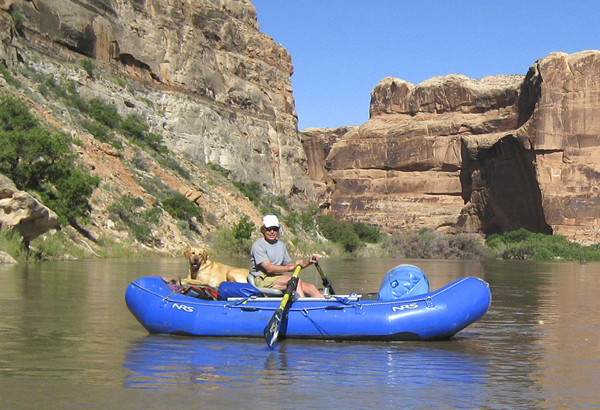
While camping with friends along the San Juan River, the author was approached by an emaciated Labrador retriever-mix. Merle, as the stray would come to be named, "looked back to the shore, and let out a resigned sigh—I was to learn that he was a great sigher." Then he boarded Kerasote's raft. At journey's end, the author took Merle home to Kelly, Wyo., a half-mile square of private land nestled among Grand Teton National Park, the National Elk Refuge and the Gros Ventre Wilderness. In this rural setting, Merle's obvious desire for independence led Kerasote to install a dog door: "Why should I treat
Merle—who had become the best of friends—like an indentured servant, at my beck and call in return for food and lodging simply because he didn't have an opposable thumb with which to manipulate the knob on the front door?" Each day, Merle (soon nicknamed "the Mayor" by neighbors) would exit through the dog door and into the heart of the village, eagerly making his rounds. A careful observer with far-reaching interests, Kerasote reflects on everything from canine decision-making to the possible origins of dog domestication to animal consciousness. In this idyllic corner of the West, the two find love (both human and canine) and friendship, forging a remarkable bond that endures until Merle's death. His passing—and the author's bereavement—are recorded with Kerasote's customary discernment. A thoughtful look at animal intelligence and the human-dog connection.
Advanced Review - Uncorrected Proof
Issue: June 1, 2007
Merle's Door: Lessons from a Freethinking Dog
Kerasote, Ted (Author)
Jul 2007. 416p. Harcourt, hardcover, $25. (978-0-15-101270-1). 636.
Merle showed up at the San Juan River at the same time Kerasote and his river-rafting friends arrived. Merle looked at Kerasote as if to say, "you need a dog, and I'm it." He accompanied the group down the river and then went home to Wyoming with Kerasote. A dog who was eager to please and almost trained himself, Merle learned the ways of bison, ground squirrels, and coyotes. Merle then taught Kerasote the fullness of the hunt, leading Kerasote to his favorite prey. But, after Kerasote installed a dog door, the main thing Merle taught him is that a dog develops to his full potential, becoming the dog he was meant to be, when allowed to make his own decisions. Merle developed a life of his own, patrolling the small settlement where they lived with his dog companions, and yet was always very aware of Kerasote and his schedule. In telling Merle's story, Kerasote also explores the science behind canine behavior and evolution, weaving in research on the human-canine bond and musing on the way dogs see the world. Merle is a true character, yet Merle is also Everydog. An absolute treasure of a book.
— Nancy Bent
The challenge and inspiration of our animal companions
By DEANNA LARSON
Throughout history, humans have tried to dominate rather than relate to nature, but this century's global issues prove that an understanding and compassionate relationship with the natural world is essential to our survival. Enlightening but never sweet or superficial, these new books legitimize the key role animals play in human lives.
The dilemma of the canine's true nature is explored by award-winning writer Ted Kerasote in Merle's Door: Lessons from a Freethinking Dog (Harcourt, $25, 416 pages, ISBN 9780151012701). Touches of a crunchy-granola-hippie philosophy infuse the story that begins when a dog approaches outdoorsman Kerasote and his friends while they're on a river camping trip in Utah. Apparently living on its own in the scrub among the Navajo, the friendly Lab mix endears itself to the whole camp; when they pack up for their next site downriver, the dog runs along the shore, unsure about leaving behind its familiar territory. But as in the best Disney story, the dog jumps into the boat at the very last second and chooses—somewhat loosely—Kerasote as his companion. Merle and the free-spirited writer return to his small Wyoming town and settle into the give-and-take of getting to know each other, mano-a-dogo. Kerasote observes, romanticizes, admires and resorts to the inexplicable to indulge, then curb Merle's behavior, confused about how to help the dog adjust to life with humans while remaining "wild." Though he often takes the observations of experts (Dr. Temple Grandin, the Monks of New Skete, Nobel Prize winner Konrad Lorenz, Dr. Richard Skinner) out of context to bolster his own preconceptions, Kerasote retains deep respect for Merle's essential nature and longing for freedom. Blasting out of his doggie door to explore the countryside, visiting neighbors and hunting wild animals then returning to home and hearth, Merle leads Kerasote to ponder, make mistakes, love and learn. The unapologetic imperfection of Kerasote's choices proves that relationships with dogs are as complicated as human ones, a reflection of our own essential humanity.
A review of Merle's Door by Ted Kerasote
Reviewed by Bob Williams Merle's Doorby Ted Kerasote. Harcourt 2007, ISBN 978-0-15-101270-1, $25.00, 398 pages Ted Kerasote has written for many publications and has written five books previous to Merle's Door, all of them concerned with the outdoors or conservation. Merle was Kerasote's dog. He was a stray dog of mixed breed who chose Kerasote. This began an intense relationship that lasted all of Merle's life. As Kerasote details his life with Merle, he also provides relevant amounts of information about dogs and what various scientists and animal psychologists have had to say about them and other animals. The book is rich in this kind of information as well as in the details of Merle's fascinating life. In the small Wyoming town where much of this story takes place, there were no great concerns about dogs and they roamed free, able to associate with each other and with the people of the town. This worked in a community in which automobile traffic was slight and everyone knew everyone else although Kerasote describes a similar and much larger community in the French Alps where much the same canine freedom obtained. Such dogs had none of the neuroses of the dog who suffers confinement for his or her own protection—and for that of others since confinement has disastrous effects. The consequent ability of Merle to be his own person had an important part in the shaping of his character. Kerasote describes the growth of that character lovingly and has a carefully founded dislike of animal behaviorists and of trainers who believe that a dog is an automaton, a being without a soul. Much of his book is taken up with his conversations with Merle and although this smacks of egregious anthropomorphism, anyone that has been around dogs will accept it without question. The door of the title is the dog door that Kerasote installed for the convenience of his companion – and, as it proved, for his companion's canine friends, a consistently well-mannered and civilized group. Readers who have been fortunate and had a dog like Merle will find the closing chapters a stab through the heart, not be read without tears. For me it brought back the grandest dog of my experience, Tasha the Thief. This is a book of great importance to anyone who loves dogs.
About the Reviewer: Bob Williams is retired and lives in a small town with his wife, dogs and a cat. He has been collecting books all his life, and has done freelance writing, mostly on classical music. His principal interests are James Joyce, Jane Austen and Homer. His writings, two books and a number of short articles on Joyce, can be accessed at: http://www.grand-teton.com/service/Persons_Places
by Geeta Nadkarni
Ted Kerasote writes movingly about a respectful and balanced relationship that spanned 13 years
MERLE'S DOOR: LESSONS FROM A FREETHINKING DOG By Ted Kerasote. Harcourt, 398 pages, $29.95
Something magical happened to me over the last two weeks as I read Merle's Door. It's as if someone flipped on streetlamps and lit up the bumpy, pothole-filled highway of interspecies understanding.
And I see now how much simpler it would be to trust my dog to navigate a good part of that terrain by herself - and how much richer we'd both be for it.
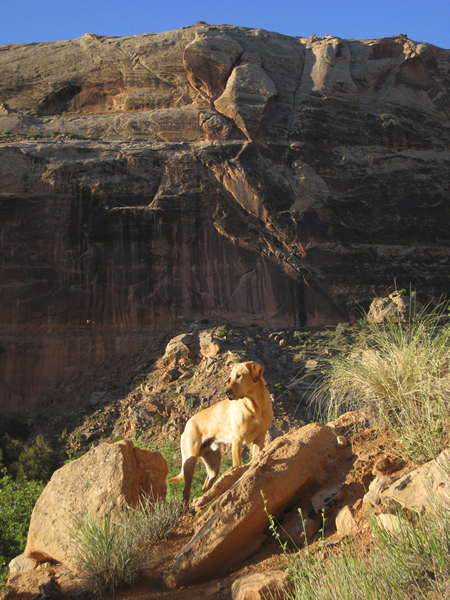
In writing Merle's Door, Ted Kerasote, a well-known and phenomenally talented nature writer, tells a love story. A story that begins one night when a big, reddish-gold dog appears out of the darkness near the San Juan River. A creature with luminous brown eyes that fix on Kerasote and say calmly, "You need a dog, and I'm it."
Following a pull deeper than logic, Kerasote decides to take this dog back to his home in rural Wyoming - that is, if the dog wants to go. And that freedom of choice - for both man and dog - sets the tone for a partnership that ends up spanning 13 years and is more respectful and balanced than most human-human relationships are.
The door in the title is both metaphorical - Merle being the door through which Kerasote discovers himself and love - and also an actual dog door that he installs in his house; a move he makes having fully considered the consequences:
But if Merle could come and go as he wished, he'd no longer be my subject or my pet. If he could make his own decisions, he might decide he didn't need me. Then again, he might love me for reasons other than my providing food and the right to take a pee. The door would change everything.
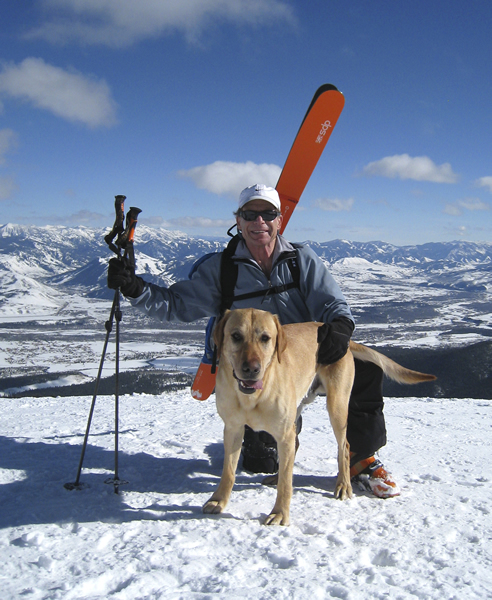
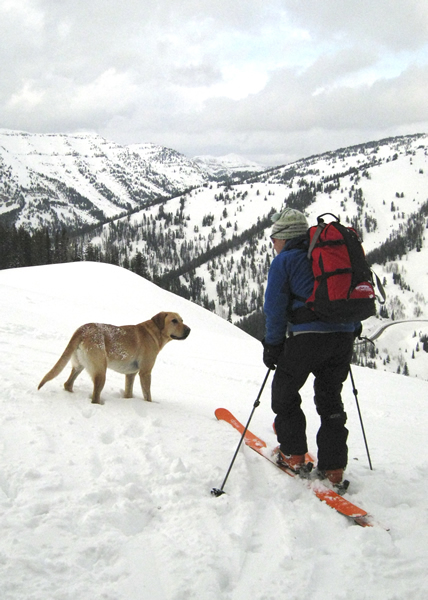
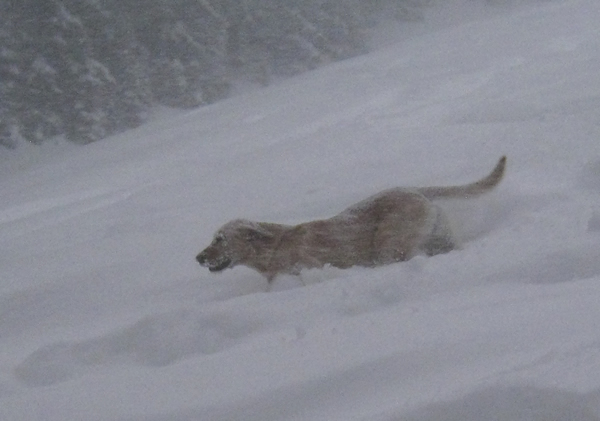
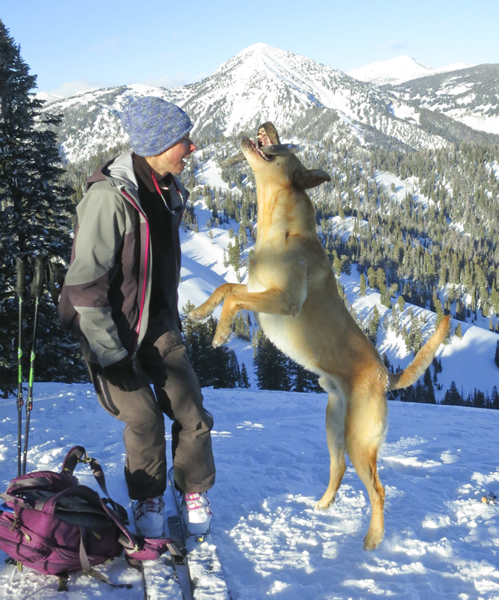
And it does. It allows Merle to grow up instead of staying the perpetual puppy that most dog owners end up with because they stifle or micromanage their animals' thinking. I cannot count the number of times I marvelled at Merle's intelligence and depth of character as I read the book, character that developed because Kerasote chose to let Merle blossom into the dog he essentially was (elk hunter, ski-dog, canine mayor of Kelly) instead of trying to train him into being something he was not (retriever, bird dog).
Of course, given that this book is essentially Merle's biography with Kerasote acting as translator, some might protest that there's a tad too much anthropomorphism. Kerasote anticipated this. He says, in Chapter 5:
Anthropomorphism is often maligned for ascribing human characteristics to animals who can't possibly know what we know. And there is some truth to this. ... But the reverse - not ascribing volition to creatures who repeatedly display it - is also inaccurate. It leads to what poor translation always does: misunderstanding between cultures.
Merle's Door contains many startling revelations. For example, much of our knowledge about dogs is essentially flawed because we've drawn conclusions about canine behaviour by studying captive wolves. This is the equivalent of theorizing about human society by observing refugee camps.
The book also reveals how sometimes the simplest explanation for an animal's behaviour is also the most complex. And how leaving doors open can make room for magic.
Kerasote has an uncanny eye for detail, and he writes with an unaffected honesty and intimacy that threatened to break my heart. I felt privileged to be let into not just the developing story of Ted and Merle, but also the parallel narratives of Allison, the love of Ted Kerasote's life, her dog, Brower, Gray Cat and the folks of Kelly, Wyoming.
Whether you like dogs or not, the sheer quality of the writing will blow you away. I do not exaggerate: this man could write a treatise on growing a beard and it would have you up reading all night! I cried as I read the final chapter of the book - not just because Merle's incredible life was coming to an end, but because the book was, too. And after, if you, like me, need a little something to fill the Merle-shaped hole in your universe, check out the only other work that occupies place of honour on my extensive shelf of animal titles: Bones Would Rain from the Sky, by Suzanne Clothier.
Geeta Nadkarni does a column on holistic, humane and eco-friendly pet care for CBC TV's Living Montreal. She shares her life with two cats and her dog, Lucie.
by Melissa Holbrook Pierson, 1/31/2008
Maybe the best thing of all is when a dog finds us, not when we go looking for a dog. Then it means you are truly meant for each other.
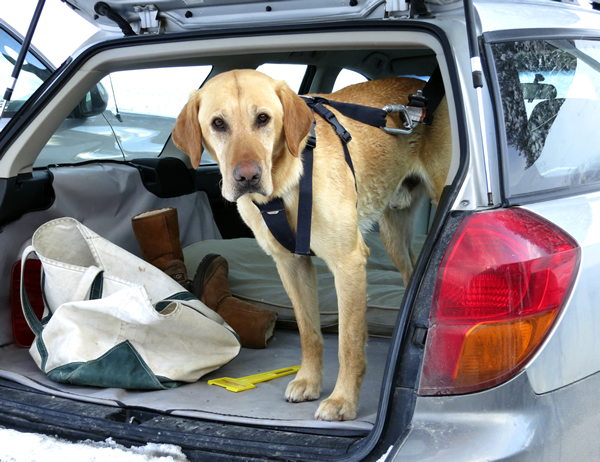
This is what happened to Ted Kerasote, an outdoor writer, when he was camping in Utah. A dog appeared to him--not a vision, but a real one, collarless, young, and red-gold in color. Kerasote looked at the hound mix and he replied, "You need a dog, and I'm it."
Truer words were never spoken, even if they were never spoken, and indeed this is one of the aims of this absorbing love story between a man and his dog: the author wants us to know that dogs have (as it were) their full humanity, too. They have their own interests, emotions, thoughts, and ultimately their own lives to live. So he puts words into Merle's mouth. There's little doubt that he hears correctly, too, at least most of the time; anyone who's ever lived with a dog knows this, that they have as full a range of desires as we do. If we listen, we will hear them speak.
The door alluded to in the title is the door to loving fully, which sometimes only a dog can fling open this wide. It also refers to the happy task of attempting to understand the species that has stood next to us for millennia.
This may be why a friend of mine, who finished reading "Merle's Door" just before I did, opined that it was a lovely book, but also a peculiarly male one. She meant that instead of losing himself entirely in the narrative of relationship, the author refocuses his lens, frequently pulling back to take in such subjects as canine history, biology, behavior, popularizing the work of experts from Nicholas Dodman to the Coppingers to Karen Pryor.
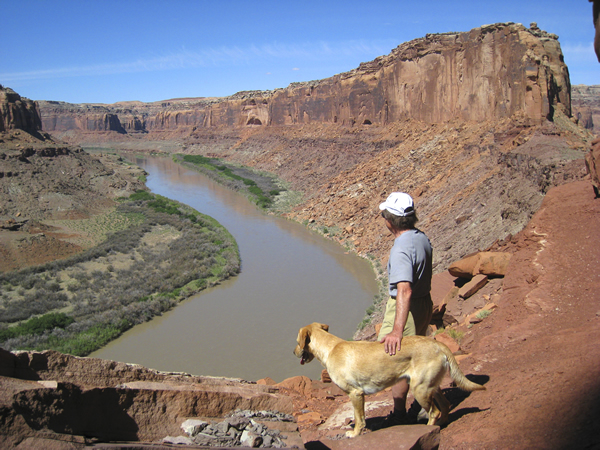
Kerasote and Merle had 13 years together, living in Kelly, Wyoming, a place where dogs can still have their full mobility, unlike most places in America, because of the lack of vehicular traffic. This is what has made prisoners of the human world out of most dogs, Kerasote thinks (along with his predecessor in exploring the essence of dogs, Elizabeth Marshall Thomas, who is also often quoted here), and he thinks it a shame. It is clear that dogs agree.
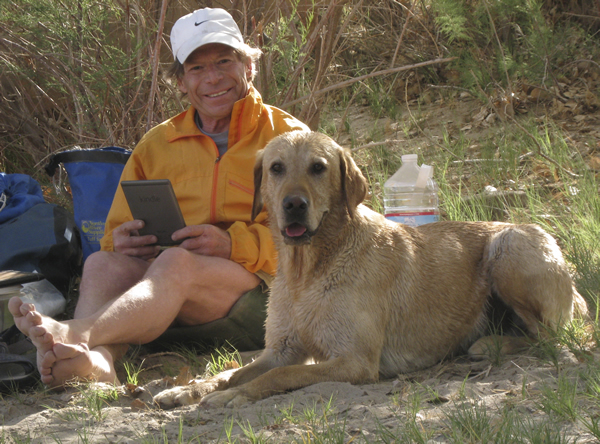
The reason Kerasote cares so much about all matters canine, though, is because he loves this one particular canine so much. It is that simple, and that deep. Together he and Merle climb mountains, hunt elk, fall in love with others but remain true to each other, and ski, after which they might also dance to bluegrass. It is a full and rich affair, and its end is heartbreaking, as all such ends must be.
Anyone not in tears during the last chapter, which is also the last chapter of Merle's great life, has a heart of stone. Judging from the water marks on the pages of my copy, mine is fully melted now.
|